

Why Airless Bottles Are Becoming the Standard for Premium Skincare
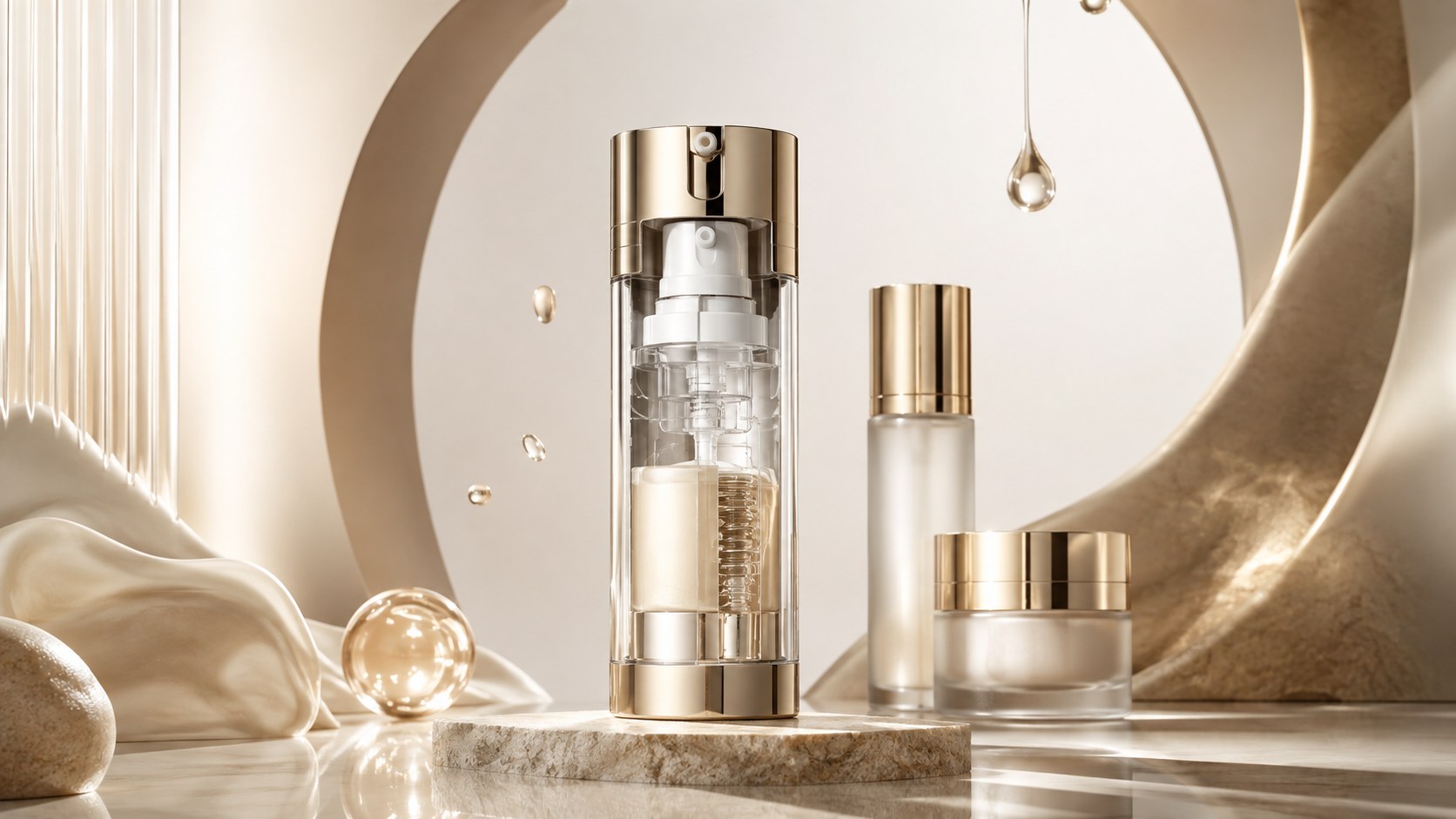
Airless bottles are a great packaging innovation that addresses multiple issues: exposure to air, dose accuracy, left-over product, and the overall feeling of value for the money spent by the consumer. However, not every serum or moisturizer requires such an involved packaging technology. For brand owners, purchasing managers, and private-label buyers, the primary consideration should be whether the product, its positioning, target market, and filling technology require an airless pump. To choose the right packaging, producers should focus on the formula and dosage and then move on to the presentation and technology.
Why are airless bottles moving from a premium look to a functional skincare requirement?
Premium skincare often uses concentrated formulas, active-led positioning, and controlled dispensing. In these projects, packaging is part of formula protection rather than an afterthought. Airless systems typically use a piston, pouch, or bottle-in-bottle mechanism instead of a conventional dip tube, allowing product to be dispensed while limiting the amount of outside air entering the product chamber.
Commercial packaging specifications also show how broad the format has become. Aptar lists one premium airless family in 15, 30, and 50 ml capacities with outputs of 150, 200, or 240 microliters, while Quadpack offers another system in 15, 20, 30, and 50 ml sizes with 0.20 cc dosing. The important point for a buyer is not to copy these numbers, but to specify the required dose for the exact formula and pack being developed.
What changes for the buyer?
The pack should be treated as part of the product specification. If a brand is developing skin and body products, the sourcing brief should state the intended fill volume, target dose per actuation, formula type, expected user gesture, decoration, target market, and whether a metal-free product pathway is required.
A supplier saying “airless available” is not enough. The next question should always be: Which airless engine is being proposed for this specific bulk?
Which formulas actually benefit from airless packaging—and which do not?
Airless packaging is worth evaluating when a formula is oxidation-sensitive, designed around controlled dosing, positioned as a concentrated treatment, or difficult to use cleanly from a jar. It can also make sense when a brand wants consumers to dispense roughly the same amount each time.
Skincare concepts built around ceramides, humectants, antioxidants, or other active-led stories may benefit from this format, but packaging cannot rescue a formula that is unstable to begin with. The same principle applies to skin barrier skincare development: formula stability, preservation, compatibility, and packaging performance need to work together.
When is airless the wrong choice?
A standard pump, tube, dropper, or jar may be more practical when the formula is inexpensive, deliberately exposed for sensory use, contains particles that could interfere with the mechanism, or falls outside the chosen pump’s validated rheology range.
There is no useful universal viscosity limit for “airless.” Different pump engines are designed for different formulas. Procurement teams should therefore request the compatibility window for the actual component being quoted.
What technical specifications should buyers lock before ordering an airless bottle?
The packaging brief should let the OEM factory and packaging supplier test the same target; a presentation sample is not enough.
| Buyer specification | What to define before approval | Why it matters |
|---|---|---|
| Fill volume | 15, 30, 50 ml or project-specific size | Affects pack size, cost, shipping and use period |
| Dose per actuation | Set a target; some commercial face-care systems are around 0.15–0.24 ml | Controls dosage and estimated uses per pack |
| Formula rheology | Viscosity and flow behavior at filling and use temperatures | Affects priming, recovery and evacuation |
| Product pathway | Plastic/metal contact, seals, valves and gasket materials | Helps assess formula compatibility |
| Priming | Maximum acceptable first-use strokes | Directly affects first-use experience |
| Dose repeatability | Agreed acceptable variation during pack life | Reduces weak or excessive dispensing |
| Restitution | Minimum acceptable product evacuation | Affects waste and consumer perception |
| Transport performance | Orientation, temperature and leakage protocol | Reduces shipment failures |
Commercial systems illustrate why these numbers must be package-specific. Aptar, for example, lists a bottle-in-bottle system intended for very high viscosity formulas with a stated product evacuation rate above 90%. That figure belongs to that system; it should not be turned into a blanket airless-packaging claim.
A useful purchasing question is therefore: “Show me the test result for our formula in this bottle,” rather than, “What is the normal airless performance?”
How should brands test formula-packaging compatibility before mass production?
Start with the production-intent bulk and actual decorated packaging whenever possible. A compatibility study should monitor dispensing, odor, color, separation, viscosity change, leakage, panel distortion, pump recovery, clogging, and visible interaction with seals or internal components.
Testing the bulk only in a glass laboratory jar can miss failures caused by the final component.
Which checks belong in the approval file?
The approval file should include the formula version, package code, component materials, batch number, storage conditions, test observations, and a signed sample. The OEM should also define when a formula, pump, seal, decoration, or packaging material change triggers retesting.
ISO 22716:2007 remains the current ISO guideline for cosmetic GMP covering production, control, storage, and shipment. It is useful when evaluating manufacturing controls, but it does not replace product-specific stability, compatibility, or safety work.
Sustainability claims need the same discipline. Refillable, recyclable, PCR-containing, or mono-material packaging should be assessed from the actual component construction rather than appearance. Brands selling into Europe can also review the practical implications discussed in EU PPWR packaging requirements before locking a long-term packaging platform.
When does premium positioning justify the higher packaging complexity?
Airless packaging earns its place when the consumer notices the benefit and the supply chain can control it. A controlled dose, cleaner actuator, strong formula-packaging fit, reduced residue, or workable refill architecture can support a premium proposition. Decoration alone does not justify the choice if the pump is inconsistent or replacement components are unreliable.
Before approval, procurement teams should compare total landed cost rather than bottle price alone. Include the pump, actuator, overcap, refill parts, decoration, assembly, testing, freight, and MOQ.
Repeat-order risk matters too. Ask whether the pump engine, bottle, actuator, and decoration process will remain available for the planned product life. Changing one component after stability work, artwork approval, and filling trials can create more cost than choosing a less complicated pack at the start.
Which OEM manufacturer can help brands coordinate skincare formula and airless packaging?
Zhejiang Limei Cosmetics Co., Ltd. provides OEM and ODM support across color cosmetics and selected skincare formats, with R&D, quality-control, filling, labeling, and packaging capabilities shown on its current website. Buyers discussing airless skincare can use the FA0618 Face Serum as a relevant product reference when defining texture, filling, dosage, and packaging direction. The website lists 300 employees, 10 R&D workers, 10 quality controllers, automated packing equipment, and 45–60 day lead time. All of this is critical for the product development process, which includes formula approval, components sourcing, compatibility checks, filling and labeling, and final packing before commercial production begins.
Conclusion
Airless bottles are most useful when formula protection, dosing, user experience, and premium positioning all support the choice. Buyers should lock pump output, rheology, material contact, priming, restitution, transport testing, and change control before production. Next, send the OEM the formula brief and packaging target together, then request compatibility samples before approving volume orders. Brands comparing packaging and filling options can contact the OEM team with both requirements.
FAQs
1. What bottle size is most common for premium airless skincare?
There is no single standard size. Packaging suppliers commonly offer facial-care airless formats around 15, 20, 30, and 50 ml. The correct volume depends on dosage, use frequency, formula cost, and target retail price.
2. Does an airless bottle mean a skincare formula needs no preservative?
No. Airless packaging can reduce exposure during dispensing, but preservation requirements depend on the formula, manufacturing controls, microbiological risk, intended use, and target market. The preservation system must be assessed independently.
3. What pump output should a buyer specify for a face serum or cream?
Start from the intended consumer dose. Commercial airless examples range around 0.15–0.24 ml per actuation for some facial formats, but the final target should be validated with the exact formula and package.
4. How should an OEM test an airless bottle before mass production?
Use production-intent formula and packaging to check priming, dose consistency, leakage, compatibility, storage stability, pump recovery, clogging, appearance, and product evacuation. Document acceptance criteria before the purchase order is finalized.
5. Are refillable airless bottles always more sustainable?
Not automatically. Material mix, refill design, transport weight, recyclability, actual refill behavior, and local collection systems all matter. Buyers should review component construction and supporting evidence before making broad environmental claims.